-
1573 Carroll St, Brooklyn, NY 11213
How DOT Sidewalk Inspections Work in NYC: What Gets Measured
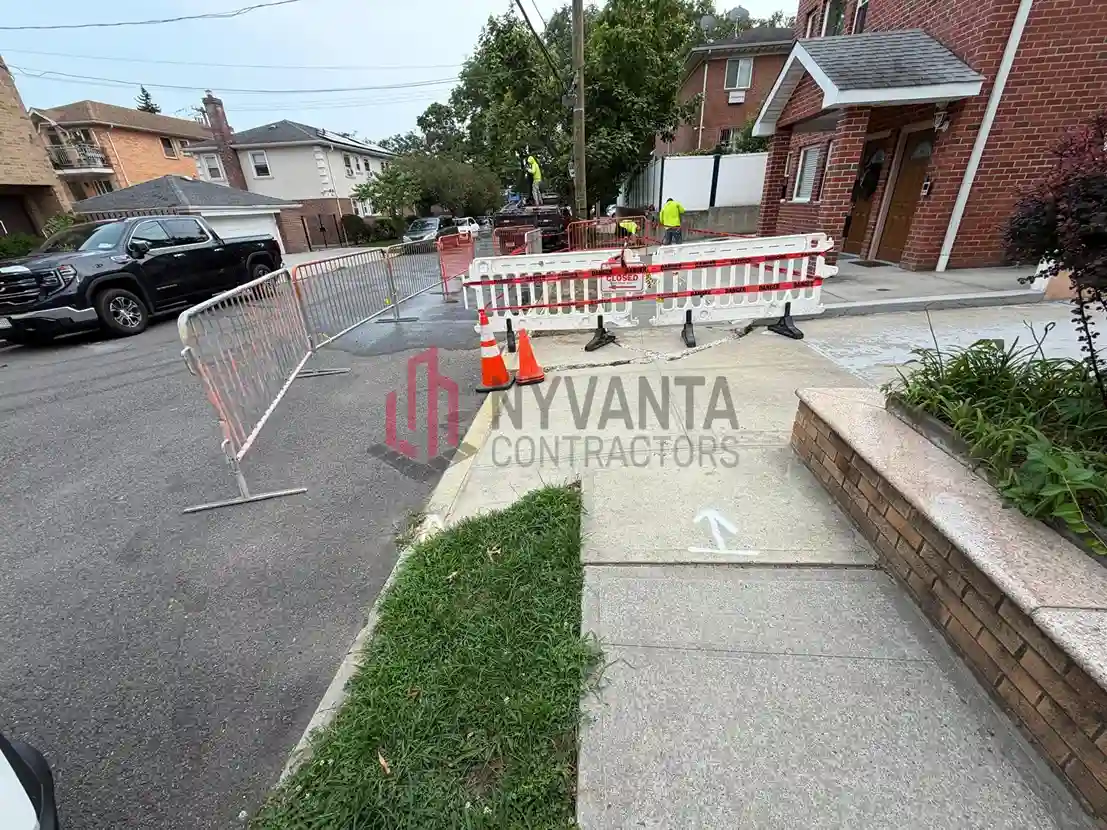
Sep 09, 2026
A New York City DOT sidewalk inspection comes down to a person with a ruler checking your concrete against a list written into the city’s Administrative Code. Half an inch of height difference between two slabs is enough to fail. So is a crack that lets a piece wiggle loose, a square that holds water instead of draining toward the curb, or a cellar door that flexes when someone steps on it. Section 19-152 spells out nine defect types, and inspectors work through them square by square.
Here is what actually gets measured and what those numbers mean once the notice lands in your mailbox.
What Triggers a Sidewalk Inspection in NYC
DOT does not inspect randomly. Inspectors are sent out based on specific criteria, including blocks where injuries were reported to the city, blocks where 311 complaints were filed, and how long it has been since the area was last surveyed. Nearby construction or utility work can also put your stretch on the list. Violations get issued in every neighborhood, so a quiet residential street is no more exempt than a busy commercial corridor.
One thing worth knowing up front: DOT inspects conditions not caused by tree roots. If a city tree is the culprit, that goes through the Parks Department’s Trees and Sidewalks Program instead, and the city no longer issues violations to one, two, and three family homes for damage caused solely by city trees.
The Flag Is the Unit of Measurement
A flag is a single square of sidewalk, the section bounded by scoring lines or joints. Inspectors do not grade your sidewalk as a whole. They evaluate each flag on its own and cite only the ones with a substantial defect. That distinction matters for your wallet, because you are responsible for repairing the flags DOT identifies, not the entire sidewalk if the rest of it is fine.
What Gets Measured, Defect by Defect
The code lists nine conditions that count as a substantial defect. Some involve a tape measure. Others are judgment calls an inspector makes on sight.
Trip hazards and the half-inch rule
This is the measurement everyone has heard about, and it is the one that catches the most property owners. If the vertical grade differential between two adjacent flags is greater than or equal to one half inch, that is a trip hazard. Full stop. There is no wiggle room and no allowance for how gradual the lift looks.
The same rule covers holes and gouges within a single flag. A surface defect qualifies if it measures one inch or greater in all horizontal directions and is one half inch or more in depth. A small chip usually passes. A pothole-shaped divot that meets both dimensions does not.
Missing, cracked, and undermined flags
-
Missing flags: If one or more flags are gone, or the sidewalk was never built at that spot, it is cited.
-
Cracked flags: The test is not crack width. It is whether the flag is cracked to the extent that one or more pieces may be loosened or readily removed. An inspector who can rock a fragment free has found a defect.
-
Undermined or loose flags: A flag with a visible void underneath it fails, as does a flag that rocks or seesaws when weight shifts across it. That void is often the first sign of erosion or a failed base.
Slope and drainage
Improper slope covers three situations: a flag that does not drain toward the curb and retains water, flags that have to be replaced to restore adequate drainage, and a cross slope that exceeds established standards. Standing water after rain is the easiest DIY check you can run on your own property, and it is a frequent finding in older concrete that has settled unevenly.
Hardware and cellar doors
Anything embedded in your sidewalk gets measured too. Hardware and other appurtenances, meaning utility caps, vault covers, and similar fixtures, must sit flush within one half inch of the sidewalk surface. Cellar doors have their own standard: they fail if they deflect more than one inch when walked on, if they are not skid resistant, or if they are otherwise dangerous.
Structural integrity
This one surprises people because a perfectly walkable flag can still get cited. A flag fails on structural integrity if it shares a common joint, other than an expansion joint, with a defective flag and has a crack that runs from that shared joint to one other joint. In practice, one bad square can pull a neighboring square into the violation.
Patchwork and spec compliance
Patchwork means less than full-depth repairs to a broken, cracked, or chipped flag, or flags built partly or entirely with asphalt or another unapproved non-concrete material. That quick asphalt smear over a crack is itself a violation. Separately, flags that do not comply with DOT construction specifications get cited on those grounds alone. The specs call for a single course of concrete four inches thick over a six-inch foundation and seven inches at driveways and corner quadrants.
How the Measurements Show Up on Paper
If the inspector finds a defect, DOT issues a Notice of Violation with a Preliminary Inspection Report attached. The PIR is a sketch of your property showing each flag, with the defective ones numbered and the specific defect types checked off against that square. Every numbered flag has to be replaced and every noted defect corrected.
The PIR also lists total defective square footage, which is how the city estimates cost. If DOT ends up doing the work, the bill is roughly that square footage multiplied by the per-square-foot rate printed on your violation letter, using the four-inch concrete rate for walking surfaces and the seven-inch rate for driveway areas. Flags marked with an X may be replaced at no charge to you, though a DDC engineer makes that call on site.
There is no fine attached to the violation itself. The real consequence is the filing: a copy goes to the County Clerk and stays there until the city confirms satisfactory repairs, which can hold up a sale or a refinance.
Your Clock, and Your Right to a Second Opinion
You get 75 days to make repairs, counted from the date you received the notice per the certified mail receipt, or from the posting date if it was posted on the property instead. That window is the same year round, so winter violations run on the same schedule, and you simply schedule the work as weather allows. Miss it, and DOT may send its own contractor and have the Department of Finance bill you.
If the defects on the report do not match what is outside your door, you can request a re-inspection within those 75 days. Compare the PIR against your actual frontage first: property width, tree locations, signs, utility caps, cellar doors. A different inspector handles the re-inspection without access to the first report, you get at least five days' notice by mail, and the result is final. And once repairs are done, the violation does not clear itself. You have to request a dismissal inspection through 311.
Get Your Sidewalk Measured Before DOT Does It for You
Every threshold mentioned above is something you can check yourself with a level and a tape measure, and every one of them is cheaper to fix on your own schedule than on the city’s. NY Vanta Contractors works with NYC property owners on sidewalk assessments, code-compliant concrete replacement, DOT permits, and violation removal from start to dismissal.
If you have an open violation or you just want an honest read on your flags before an inspector shows up, reach out to NY Vanta Contractors for a free onsite inspection and get the work handled correctly the first time.
Licensed NYC Concrete Contractor
Need Our services?