-
1573 Carroll St, Brooklyn, NY 11213
Bluestone Sidewalks, Walkways & Steps in NYC: Complete Guide
Sep 29, 2026
Walk through Park Slope, Fort Greene, Brooklyn Heights, or Carroll Gardens and you'll see it underfoot: wide gray-blue stone slabs, some over a century old, still doing the job they were quarried for in the 1880s. That's Pennsylvania bluestone, the original sidewalk material in a lot of historic Brooklyn and Manhattan.
It's still one of the most requested materials for walkways, steps, and entryways today, on and off the public sidewalk. Here's what bluestone actually is, what's allowed where in NYC, and what each application costs.
What Bluestone Actually Is
Bluestone is a dense sedimentary sandstone, quarried mainly in Pennsylvania and upstate New York, known for its blue-gray color and natural cleft texture. NYC's own Street Design Manual specifies a minimum thickness of 2.25 inches for sidewalk use, with a thermal finish (a flame-treated surface that's flatter and less slippery than natural cleft) and hand-tight joints between slabs.
Two finishes come up most in NYC projects:
- Natural cleft. Split along the stone's natural grain. Texture and slight color variation, no two slabs identical.
- Thermal. Flame-treated for a flatter, more uniform surface. This is what NYC's own sidewalk spec calls for.
Bluestone Sidewalks in NYC: What's Actually Allowed
This is the part that trips people up. The public sidewalk isn't like a backyard, and bluestone there comes with its own approval process.
Standard NYC sidewalks are concrete by default. Bluestone, brick, and granite fall under what the city calls "distinctive sidewalk" materials, and using them requires more than picking a nice stone.
| Situation | What's Required |
|---|---|
| Property in a historic district with existing bluestone | LPC governs removal, repair, and installation; in-kind replacement is typically required |
| New bluestone sidewalk outside a historic district | DOT and DDC approval, plus a Distinctive Sidewalk Maintenance Agreement with the city |
| Existing bluestone sidewalk needs repair | Salvage and reset where possible; damaged slabs may be consolidated with tinted concrete filling gaps |
| Any sidewalk work, any material | A DOT sidewalk permit |
The city has a specific rule for damaged historic bluestone sidewalks: intact pavers get consolidated into as much of the sidewalk as possible, and tinted, scored concrete fills the rest to visually match. It's a workaround for blocks that don't have enough salvageable original stone left to redo the whole thing in kind.
DOT's inspection standard for any sidewalk, bluestone included, flags cracks or height differences over 1/2 inch as a defect. A cracked or uneven bluestone slab gets cited the same way a concrete one does.
Bluestone Walkways and Pathways for Private Property
The path from the public sidewalk to your front door is a different situation entirely. That's private property, and it doesn't carry the same DOT and LPC requirements as the sidewalk strip itself, unless the property is landmarked and the walkway is considered part of a regulated historic landscape.
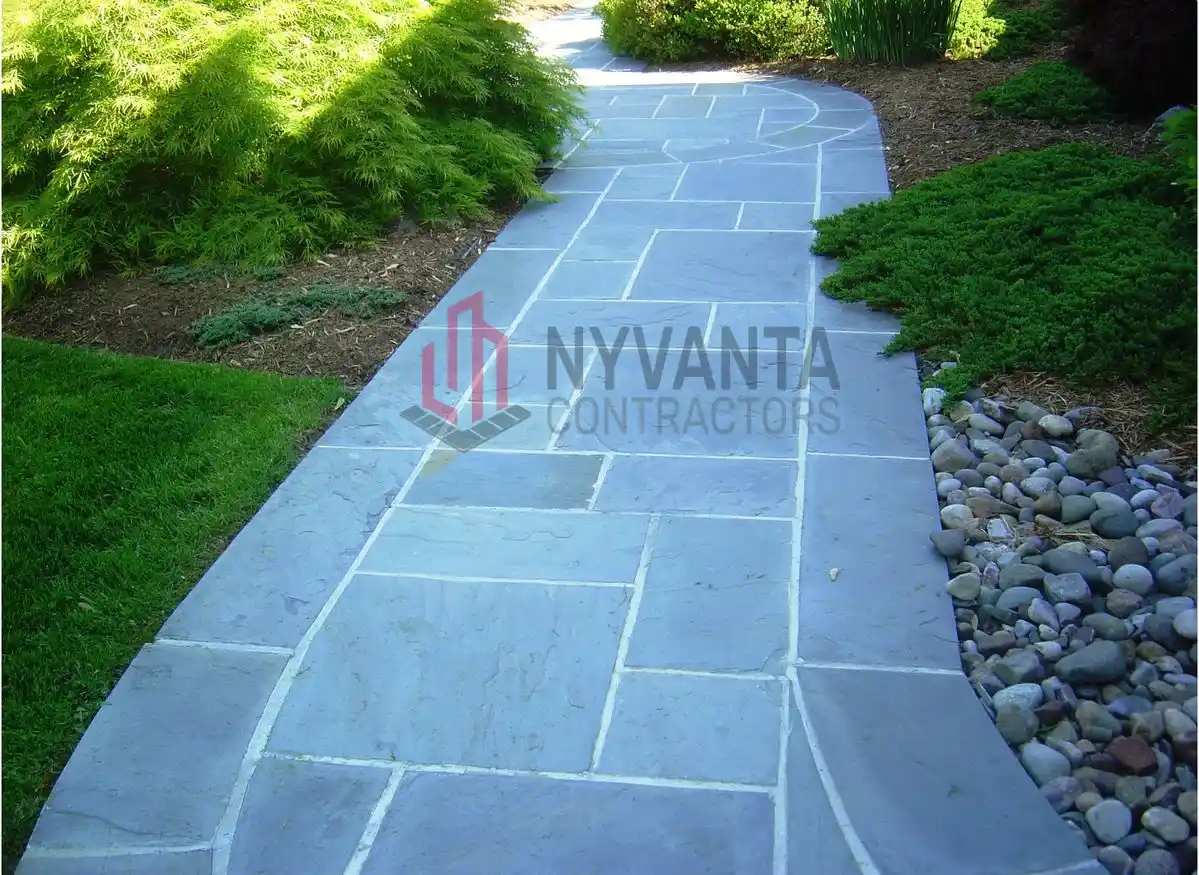
Private bluestone walkways and pathways are typically installed one of two ways:
- Dry-laid, set on a compacted gravel and sand base with sand-swept joints. More flexible, easier to reset if a slab shifts, and the traditional method for irregular natural-cleft stone.
- Mortar-set, on a concrete base with mortared joints. More rigid, better for high-traffic paths, but harder to repair if one slab cracks since the whole section may need to come up.
For a straight walkway from the sidewalk to the entrance, dry-laid natural cleft in a running or random pattern is the most common look in NYC's brownstone neighborhoods.
Bluestone Walkway in Grass and Stepping Stones
A bluestone walkway set into a lawn is a different install than a solid paved path.
Individual stepping stones or bluestone steppers get set into excavated pockets cut to the stone's thickness, on a bed of sand or fine gravel, so the top surface sits flush with or very slightly above the grass line. That height matters: too high and it's a mowing hazard, too low and grass grows over the edges.
Spacing follows natural stride, stones set close enough together for a comfortable step without the path looking like solid paving. It's a common way to bring bluestone into a front or back yard without the cost of a full paved walkway.
Bluestone Paver Walkways
"Paver" and "slab" get used loosely, but they're not quite the same product. Bluestone pavers are smaller, more uniform pieces, often 1 to 1.5 inches thick, cut for a consistent fit. Full slabs run thicker and larger, closer to what's used on a public sidewalk.
Pavers cost less per square foot in material but usually need a more prepared base, since a thinner stone flexes more without solid support underneath. For a walkway that will see regular foot traffic, base preparation matters as much as the stone itself.
Bluestone Steps and Entryways
Bluestone steps and an entry landing are usually where a project gets the most attention, since it's the first thing anyone sees walking up.
A few things matter more here than on a flat walkway:
- Finish. Thermal finish is standard for steps and treads, since a smoother but still textured surface is safer underfoot than raw natural cleft on a sloped or stepped surface.
- Thickness. Treads generally run thicker than walkway pavers, since a step has to span its full depth without support underneath the nose of the tread.
- Drainage. Steps and landings need a slight pitch so water sheds off instead of pooling and freezing.
A bluestone entryway, the landing at the top of the steps right before the door, usually gets built as a single larger slab or a tightly fitted set of pavers, since that's the spot that gets the most direct foot traffic and the most scrutiny.
Bluestone and Brick Combinations
Bluestone and brick together is one of the most common pairings in NYC brownstone and rowhouse construction, and it's requested often enough that it's worth its own section.
The usual layout: bluestone treads and landing, since it's the flatter, more slip-resistant surface to actually walk on, with brick used for the stoop's risers, side walls, or a border around a walkway. It's partly aesthetic, matching the brick facade above, and partly practical, since brick holds up well as a vertical or edge element while bluestone performs better as the horizontal walking surface.
Getting this right depends on the brick and mortar matching the building's actual facade, not just being close in color. Our guide on brick pointing and mortar matching covers what goes wrong when that match is off.
Bluestone Porch Floors
A bluestone porch floor works differently depending on what's underneath it. On a slab-on-grade porch, the installation is similar to a patio, stone set on a prepared base. On a raised porch with a wood or steel frame underneath, the stone has to be installed with the frame's load capacity and drainage in mind, since a porch floor holds water differently than one poured directly on the ground.
Either way, the same drainage principle applies as with steps: a slight pitch away from the house keeps water from sitting against the foundation or the house's siding.
What Bluestone Projects Cost
National cost data is the closest available benchmark, since NYC-specific pricing for private bluestone work isn't separately published. NYC labor and access costs typically push toward the higher end of these ranges.
| Project | Typical installed cost |
|---|---|
| Bluestone patio or walkway (pavers) | $16 to $38 per sq ft |
| Bluestone patio or walkway (natural cleft slabs) | $18 to $40 per sq ft |
| Stepping stones in grass | $16 to $35 per sq ft |
| Bluestone steps | $300 to $900 per step installed |
| Bluestone treads (material only) | $45 to $85 per tread |
| Public sidewalk (bluestone, where approved) | Priced with the DOT permit, $70 per 300 linear ft, on top of material and labor |
A small entry walkway or a handful of steps generally lands in the low thousands. A full patio or a long front walkway scales up from there based on square footage and how much cutting and fitting the layout needs.
Maintaining Bluestone
Bluestone holds up for decades when it's set right, but a few things shorten its life:
- Water getting under a slab and freezing, which is what cracks and heaves bluestone the same way it does concrete
- Sand-swept joints washing out over time and needing to be topped off
- Sealing, which isn't required but helps resist staining on lighter-colored stone
A slab that's cracked or shifted usually means the base underneath failed, not the stone itself. Resetting on a proper base solves it more permanently than just replacing the piece.
Getting It Installed Right
Bluestone work spans public sidewalk compliance, private walkway installation, and masonry detail work all at once, and getting the permitting wrong on a public-facing sidewalk means redoing the work.
NY Vanta Contractors installs and repairs bluestone sidewalks, walkways, steps, and entryways across Brooklyn, the Bronx, Manhattan, and Queens, including the DOT and Landmarks approval process where a property requires it. You can get a starting number with the free cost estimator.
Frequently Asked Questions
Is bluestone allowed on a public sidewalk in NYC?
Yes, in many cases, especially in historic districts where it was the original material. It requires DOT approval, often DDC approval, and Landmarks Preservation Commission sign-off if the property is in a historic district.
Do I need a permit for a bluestone walkway on my own property?
Generally no, if it's a private walkway between the sidewalk and your entrance and the property isn't part of a regulated historic landscape. The public sidewalk strip itself is a different situation and does need a DOT permit.
How much does a bluestone walkway cost in NYC?
Nationally, installed bluestone runs $16 to $40 per square foot depending on the stone type and pattern. NYC labor and access typically push costs toward the higher end of that range.
What's the difference between bluestone pavers and bluestone slabs?
Pavers are smaller, more uniform, and usually thinner, often 1 to 1.5 inches. Slabs are larger and thicker, closer to what's used on public sidewalks, and generally cost more per square foot installed.
Can bluestone be used for a walkway set into grass?
Yes. Individual stepping stones or steppers get set into the lawn on a sand or gravel bed, flush with the grass line, spaced for a natural walking stride.
Why is bluestone paired with brick so often in NYC?
It's a common combination on brownstones and rowhouses: bluestone for the flat, walkable surface of treads and landings, brick for risers, walls, or borders that match the building's facade.
Ready to Get Started?
Whether it's a public sidewalk, a front walkway, steps, or a full entryway, get a free estimate or call (718) 593-4048. We'll assess the site, tell you what's actually allowed for your property, and handle any permitting the work requires.
Licensed NYC Concrete Contractor
Need Our services?