-
1573 Carroll St, Brooklyn, NY 11213
ADA Sidewalks: Compliance and Repair Requirements | NY Vanta Contractors
Sep 08, 2026
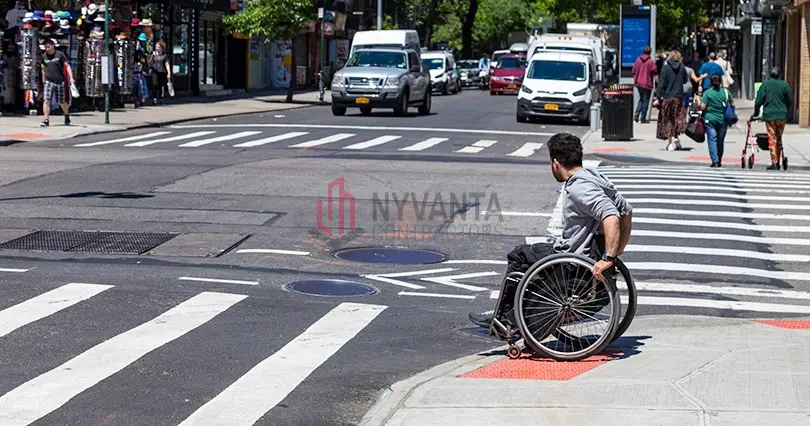
New York City spent decades in court over its sidewalks. Not the cracks and trip hazards property owners get cited for, but something more basic: whether someone using a wheelchair, walker, or cane could actually get from a sidewalk down to a crosswalk without running into a curb they couldn't cross.
That history is why ADA compliance on NYC sidewalks isn't a suggestion. It's federal civil rights law, and both the city and private property owners have been sued over it, for different reasons that end up mattering a lot depending on what kind of property you own.
What Makes a Sidewalk ADA Compliant
The Americans with Disabilities Act sets a federal floor for pedestrian routes, and a few numbers do most of the work.
Width. A sidewalk needs at least 36 inches of clear, unobstructed width. Most NYC sidewalks are far wider than that in practice, but 36 inches is the legal minimum for an accessible route. If a stretch narrows below 60 inches for any distance, a passing space at least 5 feet by 5 feet is required every 200 feet so wheelchair users going opposite directions can get past each other.
Cross slope. The side-to-side tilt of the sidewalk, usually there for drainage, can't exceed 2%. Anything steeper makes it hard for a wheelchair to track straight without drifting toward the curb.
Running slope. The slope in the direction of travel generally follows the grade of the street. If it goes past 5%, it's no longer treated as a sidewalk under ADA standards. It becomes a ramp, which brings in a separate set of requirements for handrails and landings.
Surface and trip hazards. The surface has to be firm, stable, and slip-resistant. Vertical changes between slabs are capped at 1/4 inch without any treatment. Between 1/4 and 1/2 inch is allowed only if it's beveled at a slope no steeper than 1:2. Anything beyond a half inch isn't compliant at all. That's a tighter standard than NYC's general sidewalk defect threshold, which cites a half-inch differential as a trip hazard on its own. A slab can pass a routine DOT inspection and still fall short of the ADA's accessibility standard.
Curb Ramp Requirements
Curb ramps get their own set of numbers, and they're stricter than sidewalk requirements because the stakes are higher. A ramp that's too steep isn't just inconvenient, it can tip a wheelchair backward.
- Maximum slope: 1:12, meaning one inch of rise for every 12 inches of ramp length.
- Minimum width: 36 inches, not counting any flared sides.
- Landing: A flat, level space at the top of the ramp, at least 36 inches long, gives someone room to stop and reorient before continuing onto the sidewalk.
- Flared sides: Where used instead of a straight drop-off, flares can't exceed a 1:10 slope.
- Detectable warnings: Truncated dome surfaces, in a contrasting color, are required at the bottom of every curb ramp so people with vision impairments can feel the transition underfoot before stepping into the street.
In New York City, curb ramps sit in a different legal category than the sidewalk itself. Sidewalk flags are the property owner's responsibility to repair under city law. Curb ramps, because they're classified as part of the roadway, fall under the Department of Transportation. That distinction is part of what led to the lawsuit history below.
Why NYC Takes This Especially Seriously
New York's current curb ramp rules exist because the city lost, repeatedly, in federal court.
The first case dates to 1994, when the Eastern Paralyzed Veterans Association sued the city, arguing it had failed to install ramps at intersections as required by Title II of the ADA. A 2002 settlement had the city committing money annually to ramp installation, but it set no hard deadline, and a federal court-ordered report in 2017 found that 80% of the city's curb cuts still weren't ADA compliant, 15 years after that agreement.
In 2014, the Center for Independence of the Disabled New York (CIDNY) filed a new class action, this time documenting specific conditions in Lower Manhattan: ramps that were broken and crumbling, too steep to use safely, missing detectable warnings, or ending in a pothole instead of a usable crosswalk.
That case settled in 2019. The city agreed to survey all roughly 162,000 street corners citywide, budgeted $1.55 billion over the following decade for the work, and committed to a 15-year timeline for full compliance, overseen by an independent court-appointed monitor. As of the most recent public reporting, the city had missed some of its own interim deadlines, citing both the scale of the survey and pandemic-related construction delays, though the program has continued installing and upgrading ramps citywide since.
The practical effect for property owners: curb ramp condition is now something DOT actively tracks corner by corner, and a broken or missing ramp at an intersection near a property can draw city attention that a private owner has no direct control over, since it isn't their repair to make.
Commercial Properties Face a Different Kind of Risk
Not every property is exposed to ADA liability the same way, and this is where the difference between commercial and residential actually matters.
Curb ramps and public sidewalks fall under Title II of the ADA, which applies to government entities, meaning the city bears that legal responsibility, not individual property owners. A purely residential building, with no business operating out of it, generally isn't subject to ADA requirements at all. The ADA doesn't reach private homes. The sidewalk flag in front of a residential property still has to be kept in repair under NYC's separate sidewalk law, but that's a different legal obligation from ADA accessibility, and it doesn't carry ADA's liability exposure.
Commercial and mixed-use properties are a different story. Any business open to the public falls under Title III of the ADA as a "place of public accommodation," which requires an accessible entrance and route where doing so is "readily achievable." That's a real, and recently active, source of lawsuits in New York City specifically. Legal aid organizations have documented a pattern of what are commonly called "ADA drive-by" suits: a small number of serial plaintiffs filing hundreds of near-identical lawsuits against small businesses over things like a missing entrance ramp, a ramp that's too steep, or the lack of a doorbell to call for assistance when the entrance itself isn't accessible. One Manhattan Community Board review found more than 100 non-compliant business entrances along a single stretch of avenue, and separate reporting found a handful of plaintiffs behind close to 400 such lawsuits citywide.
Federal penalties for a DOJ-pursued ADA violation currently run up to roughly $118,000 for a first violation and over $236,000 for a subsequent one, adjusted annually for inflation. Most small business cases never reach that level. They settle privately for a smaller amount plus legal fees, which is exactly the business model critics of these suits point to. Either way, the exposure is real in a way it simply isn't for a residential-only property.
One practical note: if a permanent ramp isn't feasible at a given entrance, a portable ramp can sometimes satisfy the "readily achievable" standard instead, which is worth discussing with a contractor or accessibility consultant before assuming a full construction project is the only option.
What ADA-Related Sidewalk and Ramp Work Costs
Costs vary by scope, but a few reference points help.
Bringing an existing sidewalk section up to ADA width and slope standards is priced the same way as any concrete replacement in NYC, generally $15 to $25 per square foot for full removal and repour, plus the standard DOT Sidewalk Construction Permit at $70 per 300 linear feet, with another $70 added for a corner property.
A new or upgraded curb ramp is a more specialized pour, since it has to hit an exact slope, include a compliant landing, and have detectable warning material installed and properly anchored. For a private job at a single corner or driveway, that typically runs into the low thousands of dollars depending on the rise being managed and site conditions, well below what the city's own program spends per ramp once large-scale survey work, engineering, and project management across 160,000-plus corners are factored in.
An accessible entrance ramp for a business, when one is needed, depends heavily on how much of a step-up has to be resolved. A small rise might only need a short ramp; a larger one can require a longer run with a landing and handrails, which adds cost quickly. Federal tax incentives, including a disabled access tax credit and a separate barrier removal deduction, can offset some of that cost for eligible small businesses.
Commercial vs. Residential: What Actually Differs
To put it plainly:
- Residential-only properties are generally not directly subject to ADA. The owner's legal obligation is limited to keeping the sidewalk flag in general repair under city law, separate from ADA accessibility standards. Curb ramps at the corner remain the city's responsibility either way.
- Multifamily residential buildings may have separate accessibility obligations for common areas under the Fair Housing Act, which is a different law with different requirements than the ADA.
- Commercial and mixed-use properties with a business open to the public are directly subject to ADA Title III, need an accessible entrance and route where feasible, and carry real lawsuit exposure that residential properties don't.
A landlord repairing a sidewalk in front of a purely residential building is mainly dealing with NYC's general sidewalk defect rules. A commercial property owner or business tenant is dealing with that, plus a separate and more consequential set of federal accessibility obligations on top of it.
Getting It Done Right
Sidewalk and curb ramp work that's actually ADA compliant has to hit exact numbers, not approximate ones. A slope that's slightly over 1:12, or a curb ramp landing that's a few inches short, can fail an inspection or leave a business exposed to exactly the kind of lawsuit described above.
NY Vanta Contractors handles sidewalk and curb ramp construction across Brooklyn, the Bronx, Manhattan, and Queens, building to the width, slope, and detectable warning specifications required for compliance, and pulling the DOT permit as part of the job.
Frequently Asked Questions
What is the minimum width for an ADA-compliant sidewalk?
36 inches of clear width is the federal minimum. If the sidewalk narrows below 60 inches anywhere, a 5-by-5-foot passing space is required every 200 feet.
What's the maximum slope allowed for a curb ramp?
1:12, or one inch of rise for every 12 inches of ramp length. Flared sides, where used, can't exceed 1:10.
Are residential sidewalks required to be ADA compliant?
Purely residential properties aren't directly subject to ADA requirements. They're still required to keep the sidewalk in general repair under NYC's separate sidewalk law, but that's a different legal standard than ADA accessibility.
Can a business be sued over a sidewalk or curb ramp problem even though the city owns the curb?
Yes, in a different way. The curb ramp itself is the city's responsibility, but the business's own entrance and accessible route are its responsibility under ADA Title III, and that's where most private lawsuits against businesses actually come from.
Who pays for curb ramp repairs in NYC?
The city, since curb ramps are classified as part of the roadway and fall under the Department of Transportation rather than the adjoining property owner.
Ready to Get Started?
If a sidewalk or entrance on your property doesn't meet ADA width, slope, or ramp requirements, get a free estimate or call (718) 593-4048. We'll assess what's actually out of compliance and handle the permit and construction to bring it up to code.
Licensed NYC Concrete Contractor
Need Our services?